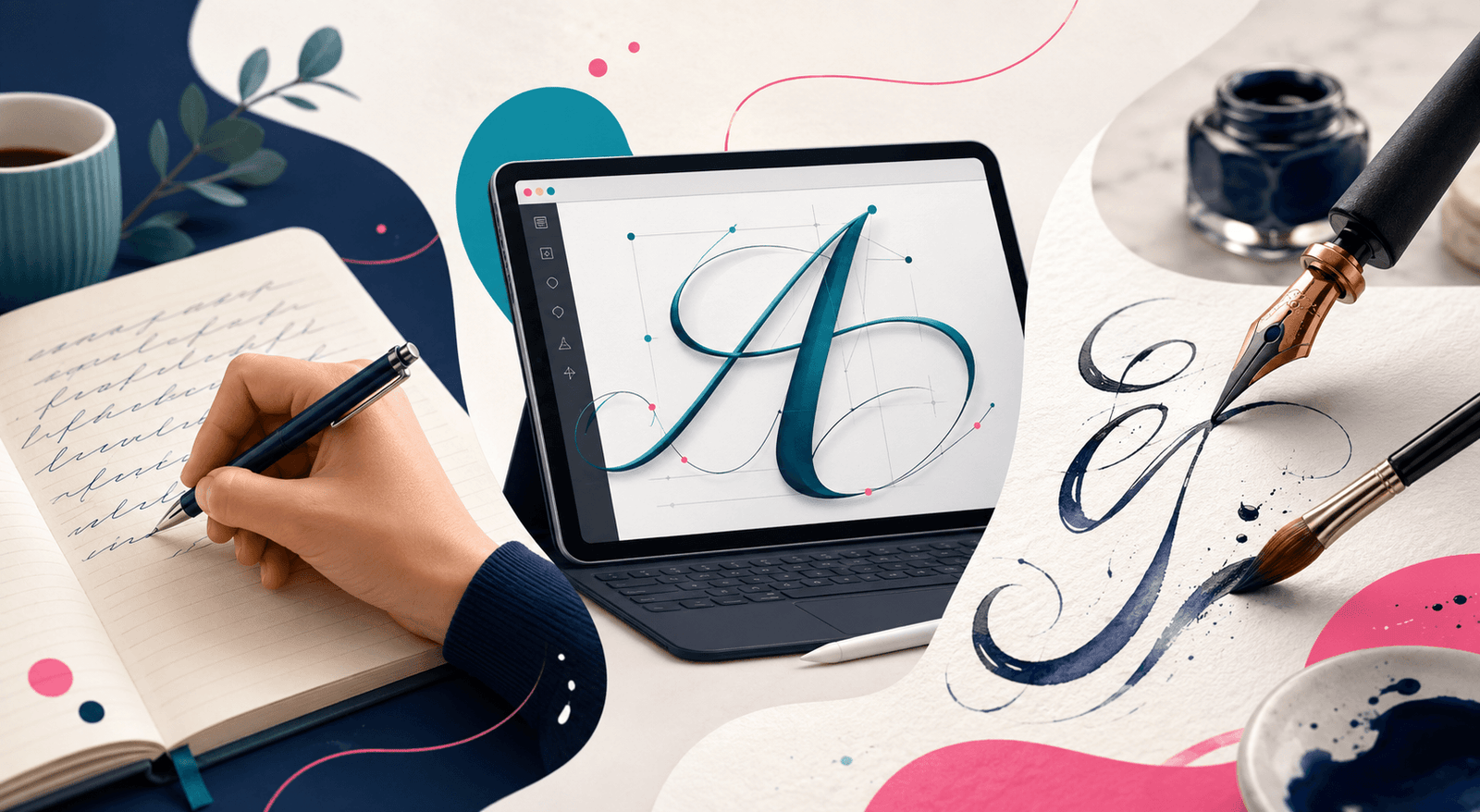
Cursive, script, and calligraphy all describe flowing letterforms, but they are not interchangeable. Cursive is primarily a way of writing, script is a broad type and lettering category inspired by handwriting, and calligraphy is the deliberate art of creating expressive letters.
Last reviewed: August 19, 2026
Cursive vs script vs calligraphy at a glance
| Term | What it describes | Typical strength | Best use |
|---|---|---|---|
| Cursive | A connected or flowing handwriting method | Speed and continuity | Notes, signatures, personal handwriting |
| Script | A broad visual category based on handwriting | Repeatable digital styling | Logos, invitations, headlines, branding |
| Calligraphy | The art and practice of intentionally formed letters | Expression and crafted detail | Artwork, formal pieces, custom lettering |
The boundaries overlap. A calligrapher can write a cursive hand, and a type designer can turn calligraphic lettering into a script font. The useful question is not which label is “correct” in isolation, but what process produced the letters and what job they need to perform.
Simple Rule
If you are describing how someone writes, cursive may be the clearest word. If you are choosing a typeface, search for script fonts. If you are commissioning hand-made letter art, ask for calligraphy or custom lettering.
What is cursive?
Cursive is a handwriting approach in which letters are written with flowing movement and are often joined within a word. Connections can reduce the number of times a writer lifts the pen, although not every cursive system joins every letter.
The Library of Congress describes modern cursive in terms of joined strokes and notes that handwriting styles change across periods and places. That historical variation explains why the cursive taught in one school or country can look different from another. See its modern cursive overview for examples and research guidance.
Common characteristics of cursive
- Letters are often connected inside a word.
- Movement and rhythm matter more than drawing each character separately.
- Personal habits create natural variation.
- Lowercase letters usually carry most of the joining behavior.
- The style can be practical, formal, or highly individual.
A signature is often cursive, but a signature can also be an abstract mark. Likewise, handwriting can be neat and flowing without meeting every rule of a particular taught cursive system.
What is a script font?
Script is the broadest design term of the three. In typography, a script typeface imitates qualities of handwriting, brush lettering, engraving, or calligraphic writing. Some script fonts connect every lowercase letter; others are deliberately disconnected.
Because a font contains designed, reusable glyphs, the same typed word can be reproduced consistently. That makes script fonts practical for branding, packaging, invitations, editorial headings, and web graphics. Adobe, for example, describes Segoe Script as a script typeface built from handwriting with connected letters, while Poetica is based on Renaissance chancery handwriting. Those examples show how the script category can range from casual to formal.
Formal, casual, and display scripts
Formal scripts often borrow from pointed-pen or engraved letterforms. They can feel elegant but require generous space. Casual scripts imitate quicker brush or marker movement and suit friendly brands. Display scripts may exaggerate loops, swashes, or contrast for short headlines and logos.
A script font is not automatically cursive. A typeface can look handwritten while keeping its letters separate. Conversely, a restrained connected font can be cursive without looking ornate.
Design Detail
Good script fonts often include alternate letters and ligatures. These variations prevent repeated characters from looking mechanical and help joins flow more naturally.
What is calligraphy?
Calligraphy is intentional letter-making in which the tool, stroke, proportion, spacing, and composition are part of the expression. A calligrapher may use a broad-edged nib, pointed pen, brush, marker, or digital stylus. The work can be traditional or experimental.
Unlike ordinary cursive, calligraphy usually prioritizes the appearance and structure of the letters over writing speed. Unlike a font, an original calligraphic piece can respond individually to the exact word, surface, and composition.
Calligraphy is a process, not only a look
A digital font can imitate copperplate, chancery, blackletter, or brush calligraphy, but choosing that font does not make the act of typing calligraphy. The typeface is a designed system inspired by calligraphic work. The distinction is similar to using a watercolor texture versus painting the original watercolor.
That does not make one medium better. A font is scalable, searchable, editable, and repeatable. Hand calligraphy is adaptable and unique. Many strong identities combine them: a custom calligraphic wordmark becomes the expressive centerpiece, while a dependable text typeface handles the supporting information.
To compare a wider range of decorative letterforms, try the calligraphy font generator.
Which style should you choose?
Choose cursive for a personal, written feeling
Cursive is a natural fit for signatures, personal notes, educational examples, and short accents that should feel human. Keep the letterforms readable and avoid long all-cursive paragraphs on small screens.
Choose a script font for repeatable design
Use a licensed script typeface when you need consistent letters across a logo draft, social graphic, invitation, or website image. Test uppercase, lowercase, numbers, punctuation, and every word in the final project before committing.
Choose calligraphy for a custom centerpiece
Commission or create calligraphy when the letters themselves are the artwork: wedding stationery, certificates, packaging marks, event signage, or a one-of-a-kind monogram. Allow time for sketches and refinement.
Pair the expressive style with a simple font
Whether you choose cursive, script, or calligraphy, contrast is your friend. Use the expressive style for a name or short heading and pair it with a clear sans-serif or serif for dates, instructions, prices, and body copy.
Find your direction
Compare related lettering styles
Type the same phrase into several generators so you can judge mood and readability fairly.
Where copy-and-paste Unicode cursive fits
Copy-and-paste cursive occupies a separate technical category. It uses Unicode Mathematical Script symbols rather than a font installed in the destination app. That makes the result portable as text, but it also changes the underlying characters.
Unicode states that these styled mathematical symbols are intended to distinguish variables in technical notation. General text should use ordinary Latin letters with styling or markup. In practical terms, Unicode cursive is best treated as a decorative accent for short bios, captions, display names, and experiments—not as the typography system for a complete article or interface.
Use our cursive letters A to Z chart to inspect the exact symbols. Some apps may not support every Unicode character, so test important names or profiles before publishing. You can also compare more styles with the Fontalic online font generator or create copyable script text with the cursive font generator.
Frequently asked questions
Is cursive the same as script?
No. Cursive usually describes a flowing handwriting method, while script is a broad typography category inspired by handwriting and calligraphy. Many script fonts are cursive, but not all.
Is calligraphy always cursive?
No. Calligraphy includes connected and unconnected hands, from italic and copperplate traditions to broad-edged and experimental lettering.
Is a calligraphy font real calligraphy?
It is a typeface inspired by calligraphic work. The design may faithfully capture the style, but typing with it is different from creating original letters stroke by stroke.
Which style is best for a logo?
A script font is efficient for early concepts, while custom lettering or calligraphy can produce a more distinctive final mark. Readability, licensing, and reproduction at small sizes should guide the choice.
What is Unicode cursive?
It is a popular name for Unicode Mathematical Script and Bold Script symbols that resemble cursive letters and can be copied as text.